
Climate adaptation in the built environment: roles, tasks and responsibilities
Climate adaptation in the built environment has been extensively developed in theory, but in practice it is lagging behind in terms of pace, scale and structural embedding. On behalf of the Ministry of Housing, Spatial Planning and the Environment (VRO), &flux, together with Arcadis, TAUW and Rebel, investigated where roles, tasks and responsibilities are currently clear — and where governance bottlenecks arise. After all, to move from ambition to implementation, we must not only know what is needed, but also who is accountable for what.
De opgave van voldoende drinkwater
Background
The Netherlands has been working for years to create a climate-resilient built environment. We are gaining an increasing understanding of what is required: more space for water, less heat stress, a more robust soil and water system, and buildings and areas that are better able to withstand extreme weather. Despite a broad understanding of risks, solutions and benefits, the built environment is still not being designed to be sufficiently climate-resilient. The primary obstacle is not substantive, but administrative: the way in which roles, tasks and responsibilities are organised, assigned and implemented.
The question is not only what we need to do, but above all: who is responsible for what?
Commissioned by the Ministry of Housing and Spatial Planning (VRO), &flux, Arcadis, TAUW and Rebel investigated how roles, tasks and responsibilities for climate adaptation in the built environment are currently organised. Not to devise new substantive solutions, but to pinpoint where implementation is stalling. Where have responsibilities been explicitly assigned? Where do gaps arise between levels of government, sectors and phases? And what is needed to embed climate adaptation structurally?
Insights
The exploratory study shows that a great deal is already happening. Local authorities are drawing up policy, water boards are contributing their expertise on water systems, provincial authorities are steering towards regional interests, market players are developing and building, housing associations are reviewing their property portfolios, and financial institutions are increasingly able to assess risks more accurately. But precisely because so many parties are involved, it is not always clear who is ultimately responsible for making integrated decisions. For example, regarding building in vulnerable areas, accepting remaining risks, or using the recovery process following damage as an opportunity to do things better in future.
That is the crux of the challenge. Climate adaptation currently often remains dependent on pilot schemes, temporary programmes, local ambition and individual commitment. Yet the transition requires structural safeguarding: in policy, regulation, funding, supervision and cooperation. Outside the realm of flood defences, the clarity needed to move from ambition to implementation is often still lacking.
How did we get here?
In this project, we mapped out the playing field. We combined desk research with online group discussions involving, amongst others, local authorities, provincial authorities, central government, water boards, drinking water companies, housing associations, construction firms, landscaping contractors, financial institutions, municipal health services (GGDs) and safety regions. In doing so, we looked at three phases: preparation, crisis and recovery. It is precisely this phasing that highlights where governance is faltering. The preparation phase is well developed in terms of content, but is not yet sufficiently institutionalised. The crisis phase is reasonably well organised for some climate-related issues, but for others — such as heatwaves — it has not yet been fully developed. The recovery phase is still in its early stages and offers opportunities not only to repair damage but also to make a structural commitment to climate adaptation in order to limit the risk of future damage.
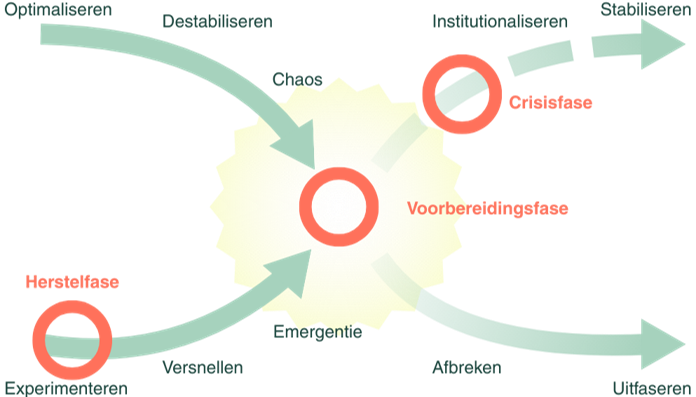
Duiding van de verschillende fase op het transitiepad volgens de x-curve van Drift
What next?
The conclusion is clear: accelerating progress does not primarily require even more knowledge or new tools, but rather explicit choices. These relate to responsibilities, powers, standards and residual risk. And to the role of central government, local authorities and private sector organisations.
This exploratory study has clarified the playing field. It thus provides a basis for making targeted choices in the next phase and for no longer treating climate adaptation as a separate add-on to area development, but as an integral part of how we build, manage and restore the Netherlands.
